


表没食子儿茶素没食子酸酯 98%
| 货号 | 规格 | 价格 | 上海 | 北京 | 珠海 | 重庆 | 武汉 | 购买数量 |
|---|---|---|---|---|---|---|---|---|
S27863-1g |
98% | ¥300.00 |
>10 | >10 | 2 | - | 1 |
|
S27863-5g |
98% | ¥850.00 |
>10 | 5 | >10 | - | - |
|
S27863-25g |
98% | ¥2000.00 |
8 | 4 | - | - | - |
|
S27863-100g |
98% | ¥4480.00 |
8 | - | - | - | - |
|
产品介绍
| SMILES: | O=C(O[C@H]1[C@@H](C2=CC(O)=C(O)C(O)=C2)OC3=C(C(O)=CC(O)=C3)C1)C4=CC(O)=C(O)C(O)=C4 |
|---|---|
| 熔点: | 222-224°C |
| 沸点: | 909.1°C at 760 mmHg |
| 比旋光度: | D -185 ±2°(ethanol) |
| 外观: | 白色至淡粉色粉末 |
| 溶解性: | 易溶于水。 |
| 储存条件: | 2-8℃ |
| 密度: | 1.9 |
| 注意: | 部分产品我司仅能提供部分信息,我司不保证所提供信息的权威性,仅供客户参考交流研究之用。 |
参考文献(79篇)
79. [IF=9.8] Fayez Khalaf Mourad et al."Ultrasound-assisted egg yolk granule–epigallocatechin gallate conjugation via multiple mechanisms for improved functionality and stability."FOOD CHEMISTRY.2025 Sep;:146478
78. [IF=9.8] Xuezhi Tian et al."A strategy to significantly improve the efficacy of high hydrostatic pressure in inactivating polyphenol oxidase using epigallocatechin gallate and ferulic acid for the inhibition of enzymatic browning: From a model system to cloudy app
77. [IF=4.1] Xuanyi Yang et al."Metabolomics and transcriptomics analysis reveals the enhancement of growth, anti-oxidative stress and immunity by (-)-epigallocatechin-3-gallate in Litopenaeus vannamei."FISH & SHELLFISH IMMUNOLOGY.2024 Dec;155:110025
76. [IF=8.5] Xuezhi Tian et al."Insight into the mechanism of high hydrostatic pressure effect on inhibitory efficiency of three natural inhibitors on polyphenol oxidase."FOOD CHEMISTRY.2024 Nov;457:140118
75. [IF=4.6] Honglin Jia et al."Microneedles Loaded with Dexamethasone and Epigallocatechin-3-gallate Reverse the Imbalance of Subcutaneous Immune Homeostasis for the Treatment of Psoriasis."Advanced Therapeutics.2023 Oct;:2300233
74. [IF=4.1] Qianwan Guo et al."Fabrication of dry S/O/W microcapsule and its probiotic protection against different stresses."JOURNAL OF THE SCIENCE OF FOOD AND AGRICULTURE.2023 Nov;:
73. [IF=1.496] Kun Xu et al."Anti-inflammatory Effect of (-)-Epigallocatechin-3-O-gallate on Human Umbilical Vein Endothelial Cells Grown on 316L Stainless Steel via STAT3/NF-κB Signaling:."Natural Product Communications.2022;17(8):
72. [IF=7.514] Liying Chen et al."Activation mechanism of whey protein isolate mediated by free radicals generated in the ascorbic acid/hydrogen peroxide system."Food Chem. 2022 Aug;384:132533
71. [IF=3.638] Jiazheng Lin et al."Effect of red light on the composition of metabolites in tea leaves during the withering process using untargeted metabolomics."Journal Of The Science Of Food And Agriculture. 2021 Sep 04
70. [IF=1.851] Li‑Li Tao et al."TSA increases C/EBP‑α expression by increasing its lysine acetylation in hepatic stellate cells."Mol Med Rep. 2017 Nov;16(5):6088-6093
69. Liu, Shuyuan, et al. "Effect of steeping temperature on antioxidant and inhibitory activities of green tea extracts against α-amylase, α-glucosidase and intestinal glucose uptake." Food chemistry 234 (2017): 168-173.https://doi.org/10.1016/j.foodchem.2017.
68. Liu, Shuyuan, et al. "Effect of steeping temperature on antioxidant and inhibitory activities of green tea extracts against α-amylase, α-glucosidase and intestinal glucose uptake." Food chemistry 234 (2017): 168-173.https://doi.org/10.1016/j.foodchem.2017.
67. Liu, Shuyuan, et al. "Effect of steeping temperature on antioxidant and inhibitory activities of green tea extracts against α-amylase, α-glucosidase and intestinal glucose uptake." Food chemistry 234 (2017): 168-173.https://doi.org/10.1016/j.foodchem.2017.
66. Qu, Fengfeng, et al. "Comparison of the Effects of Green and Black Tea Extracts on Na+/K+‐ATPase Activity in Intestine of Type 1 and Type 2 Diabetic Mice." Molecular nutrition & food research 63.17 (2019): 1801039.https://doi.org/10.1002/mnfr.201801039
65. Xiang, X., Xiang, Y., Jin, S., Wang, Z., Xu, Y., Su, C., Shi, Q., Chen, C., Yu, Q. and Song, C. (2020), The hypoglycemic effect of extract/fractions from Fuzhuan Brick-Tea in streptozotocin-induced diabetic mice and their active components characterized by
64. Yu, Penghui, et al. "Distinct variation in taste quality of Congou black tea during a single spring season." Food science & nutrition 8.4 (2020): 1848-1856.https://doi.org/10.1002/fsn3.1467
63. Pei Pu, Xin Zheng, Linna Jiao, Lang Chen, Han Yang, Yonghong Zhang, Guizhao Liang, Six flavonoids inhibit the antigenicity of β-lactoglobulin by noncovalent interactions: A spectroscopic and molecular docking study, Food Chemistry, Volume 339, 2021, 128106
62. Liu, Shuyuan, et al. "In vitro α-glucosidase inhibitory activity of isolated fractions from water extract of Qingzhuan dark tea." BMC complementary and alternative medicine 16.1 (2016): 1-8.
61. Liao, Yinyin, et al. "Effect of major tea insect attack on formation of quality-related nonvolatile specialized metabolites in tea (Camellia sinensis) leaves." Journal of agricultural and food chemistry 67.24 (2019): 6716-6724.https://doi.org/10.1021/acs.j
60. Hua, Jinjie, et al. "Influence of enzyme source and catechins on theaflavins formation during in vitro liquid-state fermentation." LWT 139 (2021): 110291.https://doi.org/10.1016/j.lwt.2020.110291
59. Qu, Fengfeng, et al. "Comparison of the Effects of Green and Black Tea Extracts on Na+/K+‐ATPase Activity in Intestine of Type 1 and Type 2 Diabetic Mice." Molecular nutrition & food research 63.17 (2019): 1801039.https://doi.org/10.1002/mnfr.201801039
58. Ge, Zhenzhen, et al. "Comparison of the inhibition on cellular 22-NBD-cholesterol accumulation and transportation of monomeric catechins and their corresponding A-type dimers in Caco-2 cell monolayers." Journal of Functional Foods 27 (2016): 343-351.https:
57. Zhang, Ying, et al. "Biotransformation on the flavonolignan constituents of Silybi Fructus by an intestinal bacterial strain Eubacterium limosum ZL-II." Fitoterapia 92 (2014): 61-71.https://doi.org/10.1016/j.fitote.2013.10.001
56. Chen, Weijun, et al. "Co‐encapsulation of EGCG and quercetin in liposomes for optimum antioxidant activity." Journal of food science 84.1 (2019): 111-120.https://doi.org/10.1111/1750-3841.14405
55. Huang, Haojia, et al. "Effect of epigallocatechin-3-gallate on proliferation and phenotype maintenance in rabbit articular chondrocytes in vitro." Experimental and therapeutic medicine 9.1 (2015): 213-218. https://doi.org/10.3892/etm.2014.2057
54. Jin, Pan, et al. "Epigallocatechin-3-gallate (EGCG) as a pro-osteogenic agent to enhance osteogenic differentiation of mesenchymal stem cells from human bone marrow: an in vitro study." Cell & Tissue Research 356.2 (2014).
53. Zhu, Tian-Tian, et al. "Epigallocatechin-3-gallate ameliorates hypoxia-induced pulmonary vascular remodeling by promoting mitofusin-2-mediated mitochondrial fusion." European journal of pharmacology 809 (2017): 42-51.https://doi.org/10.1016/j.ejphar.2017.0
52. Tang, Huaqiao, et al. "Epigallocatechin-3-gallate protects immunity and liver drug-metabolism function in mice loaded with restraint stress." Biomedicine & Pharmacotherapy 129 (2020): 110418.https://doi.org/10.1016/j.biopha.2020.110418
51. Tang, Huaqiao, et al. "Epigallocatechin-3-gallate protects immunity and liver drug-metabolism function in mice loaded with restraint stress." Biomedicine & Pharmacotherapy 129 (2020): 110418.https://doi.org/10.1016/j.biopha.2020.110418
50. Zou, Mingming, et al. "Evaluation of antimicrobial and antibiofilm properties of proanthocyanidins from Chinese bayberry (Myrica rubra Sieb. et Zucc.) leaves against Staphylococcus epidermidis." Food science & nutrition 8.1 (2020): 139-149.https://doi.org/
49. Jia, Longgang, et al. "General Aggregation-Induced Emission Probes for Amyloid Inhibitors with Dual Inhibition Capacity against Amyloid β-Protein and α-Synuclein." ACS Applied Materials & Interfaces 12.28 (2020): 31182-31194.https://doi.org/10.1021/acsami.
48. Chang, Yifan, et al. "Improved viability of Akkermansia muciniphila by encapsulation in spray dried succinate-grafted alginate doped with epigallocatechin-3-gallate." International Journal of Biological Macromolecules 159 (2020): 373-382.https://doi.org/10
47. Zhang, Xing, Hui He, and Tao Hou. "Molecular mechanisms of selenium-biofortified soybean protein and polyphenol conjugates in protecting mouse skin damaged by UV-B." Food & function 11.4 (2020): 3563-3573.DOI: 10.1016/j.foodchem.2021.129888
46. Jin, P., Li, M., Xu, G., Zhang, K., Zheng, L., & Zhao, J. (2015). Role of (-)-epigallocatechin-3-gallate in the osteogenic differentiation of human bone marrow mesenchymal stem cells: An enhancer or an inducer? Corrigendum in /10.3892/etm.2021.9725. Experi
45. Chuang Zhu, Yan Xu, Zeng-Hui Liu, Xiao-Chun Wan, Da-Xiang Li, Ling-Ling Tai, The anti-hyperuricemic effect of epigallocatechin-3-gallate (EGCG) on hyperuricemic mice, Biomedicine & Pharmacotherapy, Volume 97, 2018, Pages 168-173, ISSN 0753-3322, https://do
44. Yang, Rui, et al. "Fabrication and characterization of ferritin–chitosan–lutein shell–core nanocomposites and lutein stability and release evaluation in vitro." RSC advances 6.42 (2016): 35267-35279.https://doi.org/10.1039/C6RA04058F
43. Chen, Yinxia, and Meihu Ma. "Foam and conformational changes of egg white as affected by ultrasonic pretreatment and phenolic binding at neutral pH." Food Hydrocolloids 102 (2020): 105568.https://doi.org/10.1016/j.foodhyd.2019.105568
42. Li, Wenfeng, Kun Zhang, and Qiang Zhao. "Fructooligosaccharide enhanced absorption and anti-dyslipidemia capacity of tea flavonoids in high sucrose-fed mice." International journal of food sciences and nutrition 70.3 (2019): 311-322.https://doi.org/10.1080
41. 张恒,郑俏然,何靖柳,韦婷,刘翔,章斌.藏茶玫瑰乌梅无糖复合饮料研制及功能性成分分析与抗氧化研究[J].食品科技,2021,46(01):46-53+61.
40. 姜丽娜,李纪元,范正琪,童冉,莫润宏,李志辉,蒋昌杰.金花茶组植物花朵内多酚组分含量分析[J].林业科学研究,2020,33(04):117-126.
39. 刘行海,徐策,买文丽,郑倩,刘华,刘红.表没食子儿茶素没食子酸酯对2型糖尿病大鼠认知功能的影响及其机制研究[J].川北医学院学报,2021,36(01):14-16.
38. 薛庆,童梁成,杨智伟,汪剑龄,赵磊,周胜,彭赛,李颖.表没食子儿茶素没食子酸酯可减轻大鼠骨骼肌缺血再灌注损伤[J].中国组织工程研究,2021,25(26):4145-4149.
37. 夏兴莉,廖界仁,任太钰,马媛春,王玉花,房婉萍,朱旭君.低温处理对茶树叶片中γ-氨基丁酸和其他活性成分含量的影响[J].植物资源与环境学报,2020,29(05):75-77.
36. 乔小燕,操君喜,车劲,陈栋,刘仲华.基于滋味和香气成分结合化学计量法鉴别不同贮藏年份的康砖茶[J].现代食品科技,2020,36(09):260-269+299.
35. 马丽娜. 基于QSPR和分子动力学模拟的中药成分肠吸收预测方法研究[D].北京中医药大学,2020.
34. 王玮, 张纪伟, 赵一帆,等. 澜沧江流域部分茶区古茶树资源生化成分多样性的分析[J]. 分子植物育种, 2020(2).
33. 黄华林, 李波, 陈海强,等. 不同萎凋时间英红九号和黄化英红九号红茶品质比较[J]. 山西农业科学, 2019, 047(010):1742-1745.
32. 乔小燕, 陈维, 马成英,等. 不同仓储地康砖茶生化成分比较分析[J]. 广东茶业, 2019(5):7-10.
31. 穆青 陈亚淑 谢笔钧 杨季芳 陈吉刚 孙智达.北极海洋红球菌B7740(Rhodococcus sp.)产类胡萝卜素和类异戊二烯醌的抗氧化、抗增殖活性[J].食品科学 2018 39(11):159-164.
30. 萎凋方式对黄化英红九号红茶品质的影响
29. 乔小燕, 黄国资, 王秋霜,等. 连续化生产线加工过程中客家炒青绿茶主要品质成分的化[J]. 广东农业科学, 2014, 041(024):91-94.
28. 乔小燕, 黄华林, 李波,等. 广东客家茶树种质资源儿茶素特性分析[J]. 江西农业学报, 2019, v.31(01):30-33.
27. 杜欢欢, 蔡艳妮, 江海,等. 超高效液相串联质谱同时测定茶叶中的8种有效物质[J]. 陕西理工大学学报(自然科学版), 2017(33):74-80.
26. 蔡爽, 阮成江, 杜维, et al. 沙棘叶片,果肉和种子中黄酮类成分的差异[J]. 植物资源与环境学报, 2019(4).
25. 欧惠算,张灵枝,王维生.阿姆斯特丹散囊菌对六堡茶品质成分的影响研究[J].中国茶叶加工,2019(02):45-50.
24. 李波, 黄华林, 陈欣,等. 不同季节黄化英红九号红茶品质比较分析[J]. 山东农业科学, 2019.
23. 乔小燕, 李崇兴, 姜晓辉,等. 不同等级CTC红碎茶生化成分分析[J]. 食品工业科技, 2018, 039(010):83-89.
22. 魏琳,卢凤美,邵宛芳,袁唯.酸茶发酵过程中感官品质及主要成分变化分析[J].食品研究与开发,2019,40(14):69-74.
21. 周晓晴, 胡立文, 罗琦,等. 茶叶籽油中茶多酚和儿茶素的测定[J]. 食品工业科技, 2019.
20. 梅双, 乔小燕, 陈维,等. 半连续化生产线和传统单机加工客家炒青绿茶主要品质成分比较分析[J]. 广东农业科学, 2019(11).
19. 乔小燕, 黄秀新, 黄国资,等. "二炒"温度对传统客家炒青绿茶品质特征的影响[J]. 广东农业科学, 2015, 042(001):96-99.
18. 王婷婷 蔡自建 蒲婉欣 等. 四川绿茶感官品质与主要滋味贡献成分分析[J]. 食品研究与开发 2018 39(24):162-167.
17. 乔小燕, 李波, 何梓卿,等. 黄化英红九号红茶体外抗氧化活性分析[J]. 农产品质量与安全, 2018, 000(005):85-90.
16. 胡立文, 周晓晴, 张彬,等. 茶叶籽油中儿茶素类和咖啡因含量测定[J]. 南昌大学学报(理科版), 2018, 42(002):134-138,146.
15. 郭颖, 黄峻榕, 陈琦,等. 茶叶中儿茶素类测定方法的优化[J]. 食品科学, 2016, 37(06):137-141.
14. 黄贝, 李龙宝, 吴信洁,等. 油茶花青素还原酶基因克隆和体外功能研究[J]. 茶业通报, 2018, 040(002):71-76.
13. 阮鸣. HPLC法同时测定六安瓜片中七种活性成分的含量[J]. 南京晓庄学院学报 2016(6):37-42.
12. 王舒叆,王子元,张敏.不同抑菌剂对青稞鲜湿面中蜡样芽孢杆菌的抑制作用[J].食品科学,2020,41(13):206-211.
11. 张天晓, 王祥荣. 真丝织物上茶多酚的高效液相色谱法检测[J]. 现代丝绸科学与技术, 2020(2):4-7.
10. 陈红霞, 李灏, 吕杰,等. 普洱茶渥堆发酵中活性成分测定及其相关性分析[J]. 北京化工大学学报(自然科学版), 2013, 40(005):84-87.
9. 黄渊 岳世阳 熊善柏 等. 2种天然抗氧化剂与鲢鱼肌球蛋白的相互作用[J]. 食品科学 2019 40(04):24-30.
8. 陈斌辉, 吕圭源, 金伟锋,等. 基于正交设计和BP神经网络-遗传算法多指标综合优化茶叶提取工艺[J]. 中国现代应用药学, 2019, 036(010):1223-1228.
7. 孙陶利 周芫宇 黎绫. EGCG-β-LG纳米粒的制备及体外稳定性研究[J]. 生物化工 2020 006(001):35-37 54.
6. 何帅, 王明友, 赵季军,等. 表没食子儿茶素没食子酸酯预防高脂饮食诱导的大鼠肥胖[J]. 西部医学, 2020, 032(004):496-499,504.
5. 孔敏, 周芳, 党秀静,等. 脊髓Toll样受体4在慢性瘙痒中的作用研究[J]. 重庆医学, 2013, 42(9):961-963.
4. 李书灵 陆珏秀 余艾虹 等. 儿茶素对家兔离体小肠平滑肌收缩功能和机制的实验研究[J]. 世界最新医学信息文摘 2018 v.18(28):168-169.
3. 蒲首丞. HPLC-DAD测定大茶树和小茶树的西湖龙井茶中EGCG的含量[J]. 安徽农业科学 v.42;No.445(12):3714-3715.
2. 北拉 蒲首丞 孙梅好. HPLC-DAD测定不同时期安吉白茶中EGCG的含量[J]. 中国农业信息 2016(6):57-57.
1. 钮婧歆 郭晶 郭青 等. EGCG对富亮氨酸重复激酶2活性的影响及其作用机制[J]. 江苏大学学报(医学版) 2018 v.28;No.143(05):34-39.
质检证书(COA)
如何获取质检证书(COA)?
请输入货号和一个与之匹配的批号。
例如:
批号:JS298415 货号:S20001-25g
在货品标签上如何找到货号和批号?
例如:
批号:JS298415 货号:S20001-25g
在货品标签上如何找到货号和批号?
如何获取质检证书(COA)


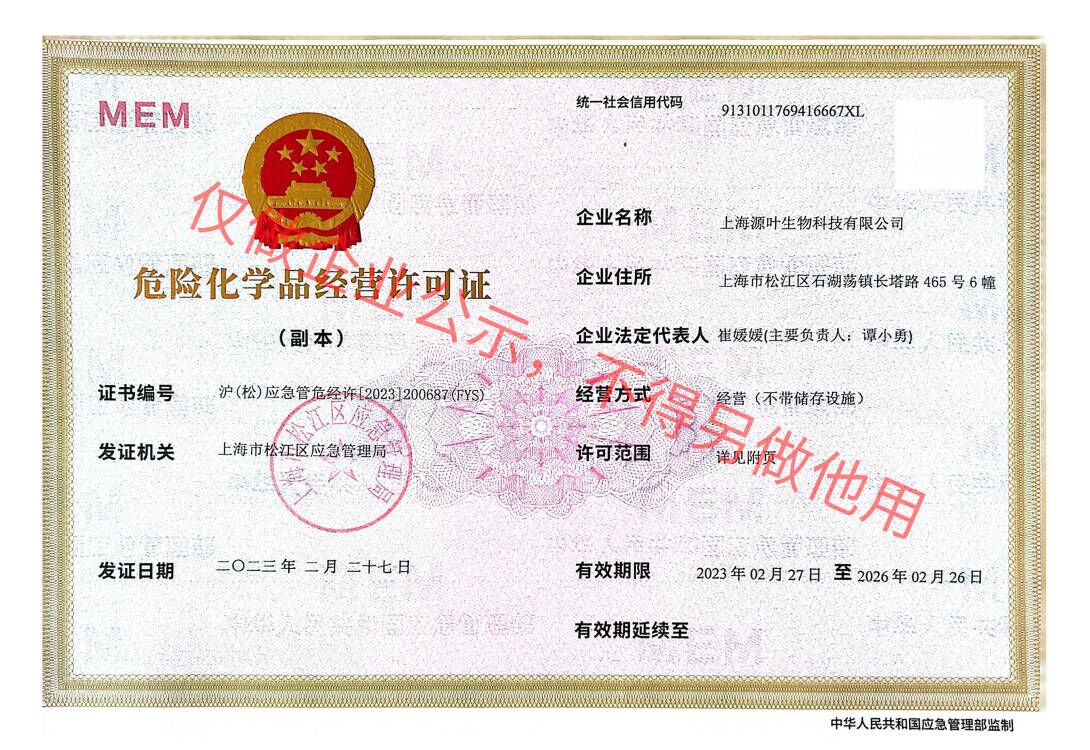 危险品化学品经营许可证(不带存储)
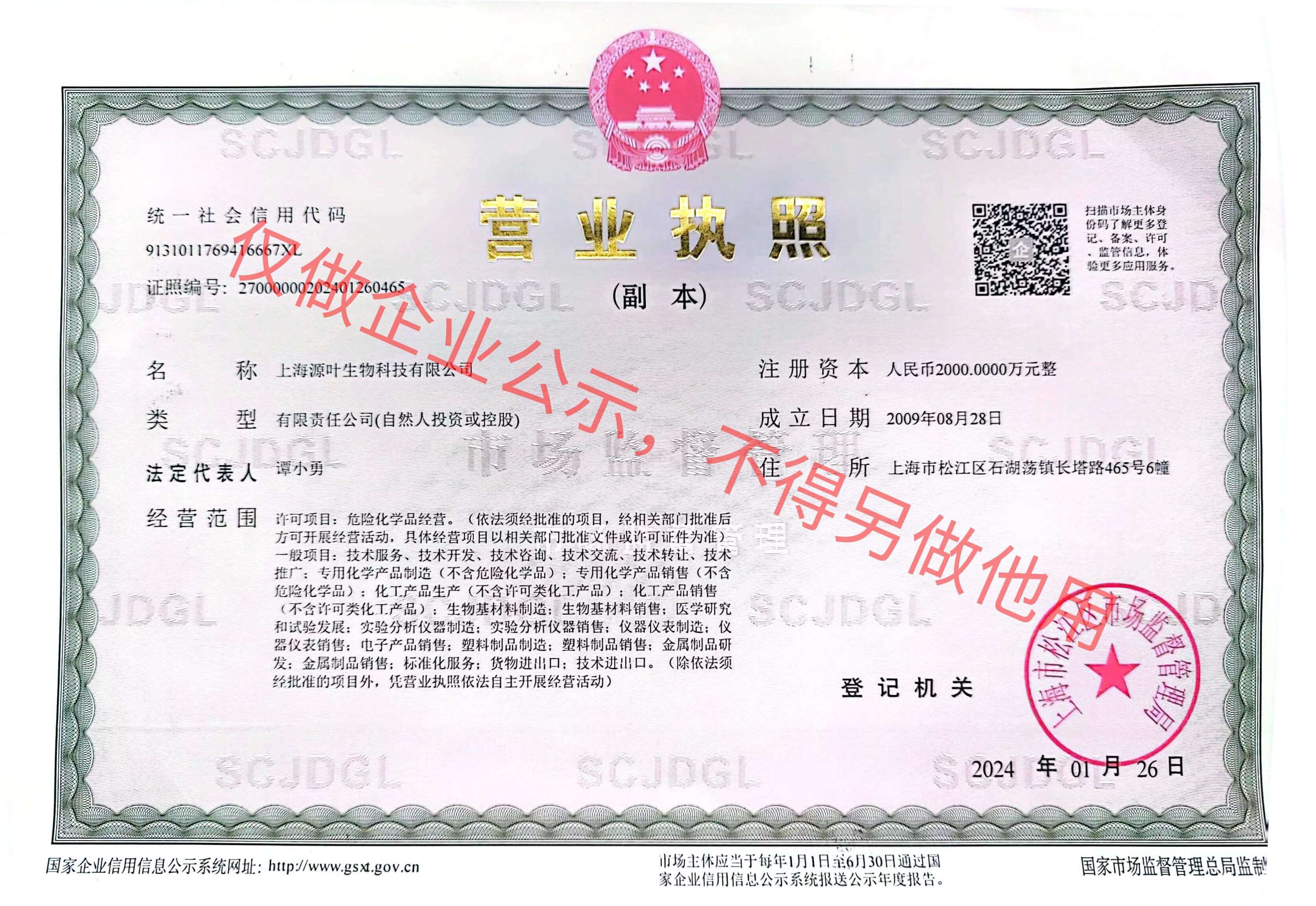 营业执照(三证合一)