



| 货号 | 规格 | 价格 | 上海 | 北京 | 珠海 | 重庆 | 武汉 | 购买数量 |
|---|---|---|---|---|---|---|---|---|
S84768-5mg |
≥98% | ¥4420.00 |
货期:3-5天 | - | - | - | - |
|
S84768-10mg |
≥98% | ¥7525.00 |
货期:3-5天 | - | - | - | - |
|
S84768-25mg |
≥98% | ¥16575.00 |
货期:3-5天 | - | - | - | - |
|
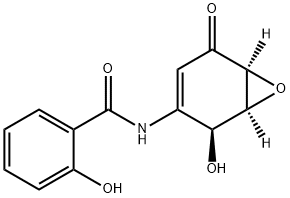
| 产品描述: | (-)-DHMEQ (Dehydroxymethylepoxyquinomicin) is a potent, selective and irreversible NF-κB inhibitor that covalently binds to a cysteine residue. (-)-DHMEQ inhibits nuclear translocation of NF-κB and shows anti-inflammatory and anticancer activity | ||||||||||||||||||||
|---|---|---|---|---|---|---|---|---|---|---|---|---|---|---|---|---|---|---|---|---|---|
| 靶点: | RelA;RelB | ||||||||||||||||||||
| 体外研究: | (-)-DHMEQ (Dehydroxymethylepoxyquinomicin; 2-10 μg/mL; 12-48 hours) treatment significantly reduces the viability of all cell lines in a dose- and time-dependent manner, whereas the effect is not significant in a control cell line K562 without constitutive NF-κB activity. (-)-DHMEQ (10 μg/mL; 0-48 hours; TL-Om1, MT-1 and K562 cells) treatment significantly increases the Annexin V-positive cells in MT-1 and TL-Om1 cell lines. (-)-DHMEQ (10 μg/mL; 4-16 hours; MT-1 cells) treatment down-regulates Bcl-xL, Bcl-2, c-myc, cyclin D1, Rb, and p53, and up-regulates proapoptotic genes such as caspase-3, -8, and-9. (-)-DHMEQ treatment increases cells in G0 /G1 phase in a time-dependent manner, demonstrating antiproliferative effects of (-)-DHMEQ. (-)-DHMEQ binds to p65, cRel, RelB, and p50, but not to p52 at specific cysteine residues. (-)-DHMEQ inhibits not only DNA-binding of RelB, but also its interaction to importin. (-)-DHMEQ also induces instability of RelB. Cell Proliferation Assay Cell Line: TL-Om1, MT-1, KK-1, ST-1 and K562 cells Concentration: 2 μg/mL, 5 μg/mL, 10 μg/mL Incubation Time: 12 hours, 24 hours, 48 hours Result: Significantly reduced the viability of all cell lines in a dose- and time-dependent manner. Apoptosis Analysis Cell Line: TL-Om1, MT-1 and K562 cells Concentration: 10 μg/mL Incubation Time: 0 hours, 24 hours, 48 hours Result: Annexin V-positive cells were significantly increased after 24 to 48 hours. Western Blot Analysis Cell Line: MT-1 cells Concentration: 10 μg/ | ||||||||||||||||||||
| 体内研究: | (-)-DHMEQ (Dehydroxymethylepoxyquinomicin; 4 mg/kg or 12 mg/kg; intraperitoneal injection; on day 0 and 3 times a week; for one month; SCID mice) treatment shows a significant increase in the survival rate in mice. Animal Model: Male C.B17-scid/scid (5 weeks old) mice injected with MT-2 cells Dosage: 4 mg/kg or 12 mg/kg Administration: Intraperitoneal injection; on day 0 and 3 times a week; for one month Result: Showed a significant increase in the survival rate in mice. | ||||||||||||||||||||
| 参考文献: | 1. Yinzhi Lin, et al. Inhibition of Late and Early Phases of Cancer Metastasis by the NF-κB Inhibitor DHMEQ Derived from Microbial Bioactive Metabolite Epoxyquinomicin: A Review. Int J Mol Sci. 2018 Mar 3;19(3):729. 2. Mariko Watanabe, et al. Dual targeting of transformed and untransformed HTLV-1-infected T cells by DHMEQ, a potent and selective inhibitor of NF-kappaB, as a strategy for chemoprevention and therapy of adult T-cell leukemia. Blood. 2005 Oct 1;106(7):2462-71. 3. Quach HT, et al. Eudesmane-Type Sesquiterpene Lactones Inhibit Nuclear Translocation of the Nuclear Factor κB Subunit RelB in Response to a Lymphotoxin β Stimulation. Biol Pharm Bull. 2017;40(10):1669-1677. | ||||||||||||||||||||
| 溶解性: | Soluble in DMSO | ||||||||||||||||||||
| 保存条件: | -20℃ | ||||||||||||||||||||
| 配置溶液浓度参考: |
|
||||||||||||||||||||
| 注意: | 部分产品我司仅能提供部分信息,我司不保证所提供信息的权威性,仅供客户参考交流研究之用。 |


 上海工商
沪公网安备 31011702002021号
上海工商
沪公网安备 31011702002021号
 危险品化学品经营许可证(不带存储)
 营业执照(三证合一)

 北京
北京