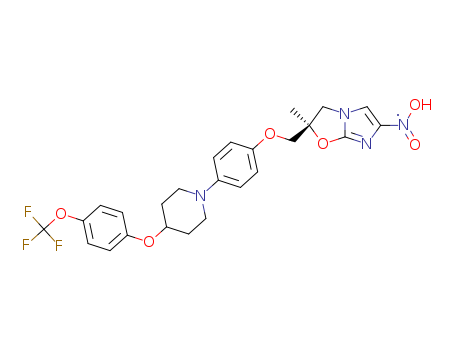
| 产品描述: | InformationDelamanid (OPC-67683) is a new anti-tuberculosis drug with an excellent intracellular bactericidal activity and a high accumulation rate.In vitroDelamanid potently inhibits the synthesis of mycolic acid, a long-chain fatty acid of the M. tuberculosis (mycobacterium tuberculosis) cell wall. Delamanid at concentrations of less than 5 μM shows no inhibitory effects on the efflux ABC transporters P-gp, BCRP, and BSEP or on the hepatic or renal SLC transporters OATPs, OCTs, and OATs. Delamanid is not metabolized by NADPH-dependent reactions, including those catalyzed by CYP enzymes, in human or animal liver microsomes. Also, delamanid has no inhibitory effects on the metabolism of exogenous CYP substrate compounds by eight CYP isoforms (CYP1A2, CYP2A6, CYP2B6, CYP2C8/9, CYP2C19, CYP2D6, CYP2E1, and CYP3A), even at a concentration of 100 μmol/liter, well above the therapeutic concentrationIn vivoThe water solubility of delamanid is poor and its absorption is increased more than two-fold by coadministration with food. The absolute bioavailability is unknown but estimated to be between 25% and 47%. delamanid is more than 99% protein bound, with a high volume of distribution (Vz/F of 2100 L) and a half-life of 30-38 hours. Delamanid is excreted primarily in the stool, with less than 5% excretion in the urine. It is thought to be primarily metabolized by albumin, with secondary contributions from P450 enzymes, primarily CYP3A4. Animal studies indicate that delamanid is excreted in breast milk. |




 上海工商
上海工商
 危险品化学品经营许可证(不带存储)
 营业执照(三证合一)

 北京
北京